The Legal Clone
- Hamburg, Germany
Dieser Artikel ist auch auf Deutsch verfügbar.
In 1982, Compaq spent one million dollars and twelve months to legally outsmart IBM. Today, one night is enough.
To understand why this matters, we need to go back to when IBM controlled the PC market. They didn’t build the first PC, but they built the one that defined the market. Within two years, they controlled 76 percent of the business customer market.1 Software was written for IBM. Peripherals were built for IBM. And in every IT department in America, one phrase circulated: Nobody ever got fired for buying IBM.
For every other manufacturer, this was a nightmare. If you wanted to sell hardware, you needed IBM compatibility. And IBM compatibility depended on a single piece of software: the BIOS.
The Basic Input/Output System is the firmware that runs when you power on, before the operating system starts. Every program that ran on an IBM PC expected certain BIOS functions via standardized software interrupts. If you had a different BIOS, you had an incompatible computer. And IBM had copyrighted that BIOS.
Copying meant lawsuits. And IBM sued. Columbia Data Products, Corona Data Systems, Eagle Computer, Handwell Corporation—all were sued or forced into settlements.2 The corporation defended its monopoly with an aggressiveness remarkable even for the eighties. Reagan in the White House, cocaine in the boardrooms, and the firm conviction that the market would sort everything out—even without lawyers.
In November 1982, Compaq presented a solution that had cost one million dollars and coined a term that’s relevant again today: the Clean Room.3
Two Rooms, Zero Contamination
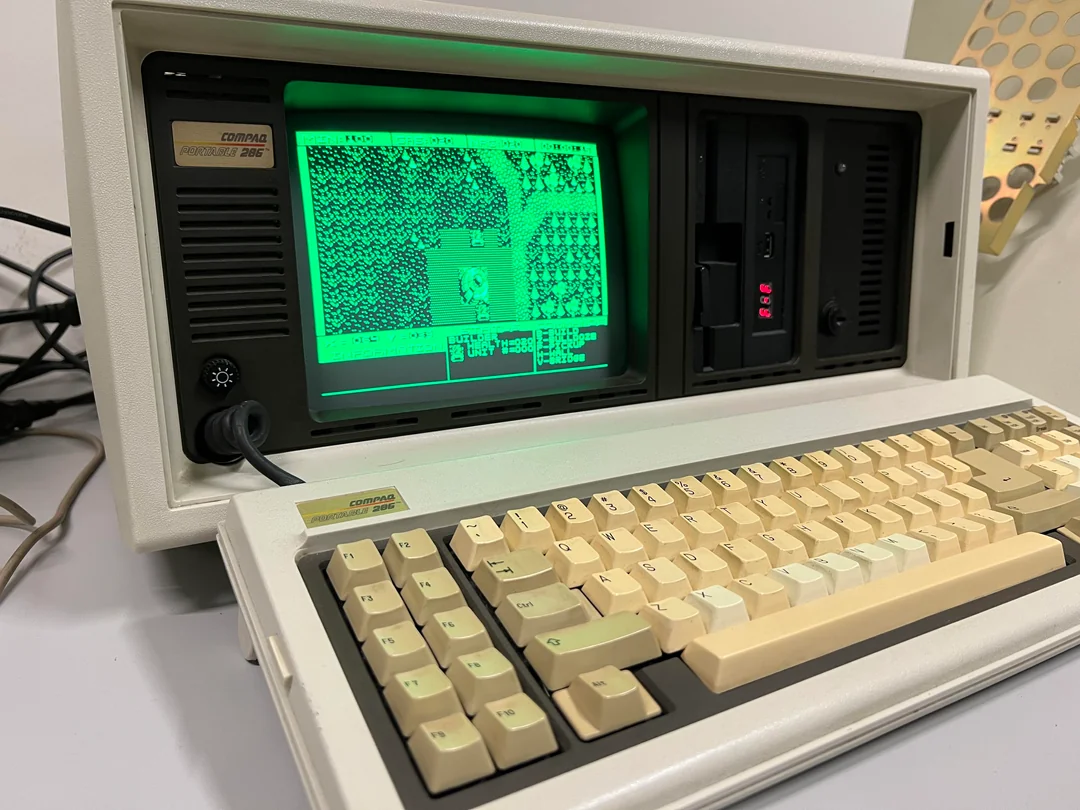
Compaq faced a problem that seemed unsolvable. To build an IBM-compatible computer, they needed a BIOS that behaved exactly like IBM’s. But IBM’s BIOS was copyrighted. Copying was illegal. And yet they found a way. In the end, IBM could only watch.
The trick was based on a fundamental principle of copyright law. The law protects the concrete implementation, not the idea behind it. You can’t copy a novel, but the story behind it belongs to no one. The same applies to software. The code is protected, its behavior is not.4
Compaq exploited this with calculated precision. Team One disassembled the IBM BIOS and documented exclusively what it did. Every observation went into a specification, lawyers checked every sentence for wording that came too close to the original.
Team Two sat in a different part of the building, physically separated and monitored under protocol. These developers never saw a single line of IBM code. They only received the legally vetted specifications and wrote a BIOS from them that produced identical behavior through completely different code. A strange job: rebuilding software you’re not allowed to look at. Like painting a portrait from a description, without ever having seen the face.5
The separation wasn’t theatrics—it was the legal core. It documented in a court-proof manner that no code was copied. Only behavioral descriptions. And behavior cannot be protected.
IBM looked for an angle of attack and found none. Compaq had copied nothing. They had only rebuilt what the software did. In its first year, Compaq sold computers worth 111 million dollars, writing the most successful company launch in American business history.6
Forty Years Later, the Same Idea

The clean room method worked because humans worked in separate rooms. But what if you no longer need the rooms? What if an LLM can replace both teams, in different contexts, with no memory of the previous one?
Geoffrey Huntley, an Australian developer, built exactly that.
His RALPH loop, which I described in an earlier article , is an endless loop that sets an LLM on the same task over and over.7 The interesting part isn’t the forward mode that most people use to build new software. It’s the reverse mode.8
Phase One studies behavior. No source code, just documentation, user guides, API references. From this, specifications emerge.
Phase Two reads only these specifications and implements. A fresh context, an empty mind—exactly like Team Two at Compaq, the developers who never saw a single line of original code.
Huntley calls it a “bitcoin mixer for intellectual property.”9 With bitcoin mixers, you throw coins in, they get mixed with others, and what comes out can no longer be traced back to the origin. Here it works similarly: you feed a model with product documentation, generate specifications, clone the functionality. The output is functionally identical, but the code is new. He runs four such agents cloning software while he sleeps. HashiCorp Nomad, Tailscale, Infisical—all products with enterprise features behind paywalls.10
What happens when the best engineers leave a company and use this technique? Tailscale has raised 130 million dollars. What is that valuation worth when a competitor can enter the market with radically lower costs?
Copyright protects code, not behavior. IBM couldn’t close this loophole. In 1982, Compaq needed one million dollars, two separate teams, and a year to exploit it. In 2026, you need a laptop, an API subscription, and one night. I tried it. It works.
-
NTARI, How Clean Room Reverse Engineering Built the Modern Tech Industry , 2023 ↩︎
-
Wikipedia, IBM PC compatible ↩︎
-
All About Circuits, How Compaq’s Clone Computers Skirted IBM’s Patents , 2023 ↩︎
-
This distinction between expression and idea is internationally established: In the US through precedents like Sega v. Accolade and Sony v. Connectix (1999) . In Germany through § 69a Abs. 2 UrhG . In the EU through Directive 2009/24/EC, Art. 1 . ↩︎
-
The clean room method was first recognized by a US court in the case NEC v. Intel . ↩︎
-
Tom’s Hardware, This week in 1982, Compaq announced the first true IBM PC clone , 2024 ↩︎
-
HumanLayer Blog, A Brief History of Ralph , 2026 ↩︎
-
Geoffrey Huntley, Ralph Wiggum as a “software engineer” ↩︎
-
Geoffrey Huntley, The Six-Month Recap , 2025 ↩︎
-
Geoffrey Huntley, The Six-Month Recap , 2025 ↩︎